

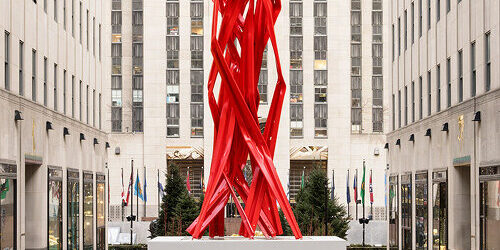
Innovative German artist Bettina Pousttchi’s groundbreaking new installation has taken root in the heart of New York City, providing citizens an experience merging the concepts of artwork and public infrastructure into one fascinating display.
Her large-scale, outdoor sculpture named “Guardrail” is now prominently displayed at the former traffic island located at the intersection of 5th Avenue and West 24th Street. Different networks of news sites have started coverage of this remarkable piece, congregating its artistic value and significance in public space.
The sculpture, a part of the Public Art Fund’s initiative to bring unique outdoor exhibitions free of cost to the public, is open for viewing from November 3, 2021, until April 17, 2022. This event marks Pousttchi’s debut in New York City.
Best known for her interventions in public spaces, Pousttchi utilizes familiar elements of urban infrastructure to generate conversations about social systems and memory. She rigorously repurposes elements derived from public infrastructure as sculptural components to create a dialogue between the built environment and its inhabitants. Guardrail continues this theme and aligns itself as a piece that challenges the conventional use of public infrastructure.
The Guardrail sculpture is not seen merely as a physical object but an embodiment of space-transforming influence, landscape alteration, and public participation. Composed of the eponymous guardrails typically found along highways, the sculpture snakes its way dramatically across the traffic island. Sculpted from aluminum cast from actual NYC Department of Transportation (DOT) guardrails, it is a tangible representation of how public infrastructure can be transformed into public artwork.
To those viewing the sculpture, the guardrails seem haphazardly twisted and turned, taking the shape of a roller coaster, a road, or waves in motion. This deconstruction and reconstruction of urban material into a work of art provide a completely fresh perspective on how city dwellers perceive the cityscape.
Pousttchi’s Guardrail demonstrates the interconnectedness of city life and the overlapping roles of city spaces. It acts as a symbol of city movement and flow, drawing a parallel between the perpetual motion of city life and the fluidity of her sculpture.
The sculpture’s placement on a former traffic island—generally a transitory space for pedestrians—adds another layer of subtext. This location was exclusively chosen by Pousttchi and the Public Art Fund as it was previously a non-place, a place of pure transition with no identity of its own. Consequently, the guardrail’s purpose, typically intended to guide or restrict movement, is humorously flipped on its head in this context.
Focusing on the importance of public art, the Public Art Fund continues to commit to pushing the possibilities of bringing contemporary art to the city space. Like many of their exhibits, Guardrail revives forgotten or underutilized public spaces, showcasing the power of such art forms to reshape the city’s everyday landscapes.
Bettina Pousttchi’s ethos resonates in this transformation of public infrastructure into public art. Through her work, she encourages the consideration of different realities, histories, and potential narratives existing in a shared public space.
Social media platforms have started taking notice of Pousttchi’s unique approach, with urban design enthusiasts, architecture critics, and the general public sharing and debating its implications. The guardrail sculpture not only has become a talking point in the contemporary art scene of New York but also a hotspot for selfies, therefore becoming an integral part of the city’s virtual landscape.
In conclusion, this innovative and thought-provoking guardrail sculpture remarkably redefines the interaction between art and public infrastructure. As the public art scene continually evolves, it will be intriguing to see how the infusion of art in cityscapes by artists like Pousttchi continues to transform our interactions with urban spaces.
Original Source: https://www.designboom.com/art/street-infrastructure-sculpture-bettina-pousttchi-rockefeller-center-installation/


