

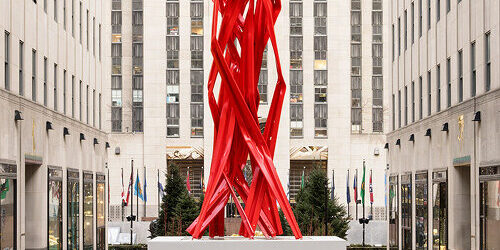
German artist Bettina Pousttchi’s expansive public art installation, reimagining city guardrails as an objet d’art, has made its debut in the city that never sleeps, New York City. Located at the High Line Plinth, Manhattan, the large-scale sculpture, titled “Panorama,” bridges the gap between public infrastructure and public art, transforming pedestrian safety railings into a captivating sight to behold.
Built on the site of the elevated freight rail line of yesteryears, the Plinth is part of the High Line park which has continuously functioned as an intersection of modern design, nature, and public art since its inception in 2009. The open-air venue has showcased works from numerous artists, offering them a platform to reach a diverse public audience.
The arrival of Pousttchi’s work draws similarities between the High Line’s past and the present, serving as a tangible reminder of the intersection between urban life and art. It impartially continues the narrative of the High Line as a connector between the city’s commercial, industrial past, and its present as an artistic hub.
“Panorama” comprises standard-issue guardrails that resemble the ones found throughout New York City and other global metropolises, symbolizing an easily overlooked aspect of urban living. Brough together in a swirling, undulating design, the guardrails create an endlessly looping panorama – a few steps back, and spectators can see a city skyline etched in metal.
Pousttchi’s work has gained international recognition for her innovative engagement with urban spaces and architectural interventions, rendering ordinary city elements into stimulating works of art. This installation marks the German artist’s first major commission in the United States and her largest artwork to date, both in physical scale and public outreach.
Pousttchi’s guardrail installation is a part of ‘The High Line Plinth’, a series of rotating exhibits intended to bring innovative, thought-provoking public art to a wide audience. In making everyday pieces architecturally spectacular, the artist aims to change how passersby see and interact with the ordinarily mundane.
According to Cecilia Alemani, Donald R. Mullen, Jr. Director and Chief Curator of High Line Art, the decision to showcase Pousttchi’s “Panorama” was due to its ability to showcase the collective societal experience while capturing the swirling motion of the city. Its large-scale and metallic nature reflect ‘the chaos and rhythm of life in New York City’.
The installation of “Panorama” comes as many in the city emerge from Covid-19 restrictions with a renewed appreciation for their surroundings. The uncanny timing of its arrival, as residents explore their city anew, offers a unique perspective on the city’s infrastructure turned into art.
The online reaction to Pousttchi’s guardrail installation has been enthusiastic, engaging social media users and art critics alike. Followers of The High Line Instagram account, which has over 260k followers, have taken numerous photos at the guardrail installation and shared them on the platform.
From local art enthusiasts to global tourists, the protected pedestrian walkway now offers more than just views of the Hudson River and the city skyline. It is another piece of New York City’s artistic landscape, thanks to Bettina Pousttchi’s creative transformation of pedestrian guardrails into a piece of public art.
This latest project from Pousttchi alters conventional city elements into an eye-catching work of art. It is a testament to how art can take the everyday and breathe new life into it, turning the commonplace into the extraordinary. “Panorama” brings into sharp focus the constant interplay between art and city life, underscoring the idea that beauty can be found in the most unexpected places.
Original Source: https://www.designboom.com/art/street-infrastructure-sculpture-bettina-pousttchi-rockefeller-center-installation/


