

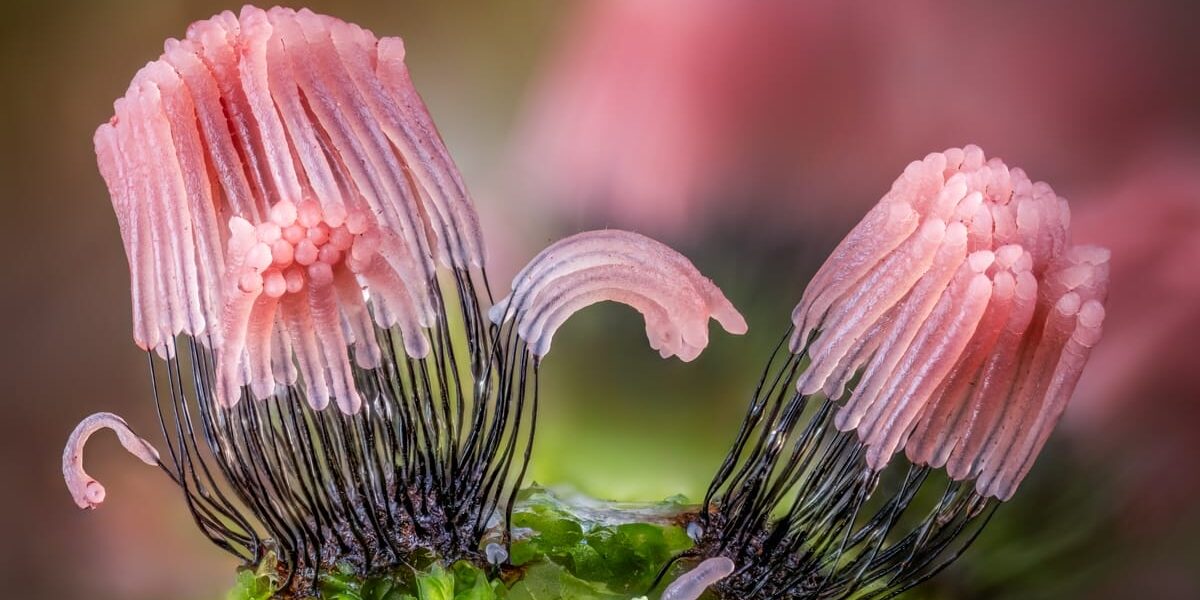
One might not expect the term “beautiful” to be anywhere near “slime mold”, yet Barry Webb has managed to pair these words together in a magnificent and distinctively scientific fashion. Colorful, captivating, and perhaps a tad quirky, the macro array of slime molds documented by Webb has gained notable attention from both the scientific community and general public.
Slime molds, or myxomycetes, are complex single-celled organisms that fall under the banner of Protista and inhabit dark, damp places. These oft-overlooked organisms have remarkable traits, capable of moving and forming into colonies that seem to ‘think’ and ‘remember’. Webb’s comprehensive study provides a unique overview of the dazzling diversity and richness of these microscopic world inhabitants.
Using advanced macro- and micro-photography techniques, Webb has captured striking images of these intriguing organisms. The variety of these slime molds is surprising: from the electric yellow of Fuligo septica to the deep crimson hue of Tubifera ferruginosa, the vibrant coral of Arcyria denudata, or the more understated yet mesmerizing white of Lycogala epidendrum. Through his work, Webb is challenging our perception of beauty in nature, inviting us to consider the visual symphony found in the most unlikely of places.
Webb’s documentation has sparked a wave of intrigue and appreciation online. Scientists and enthusiasts alike have shared his kaleidoscopic picture series on social platforms, educational sites, and blogs, thereby boosting the visibility of this uncommon field study. His rare lens has garnered a valuable spotlight on the intriguing biology of slime molds, generating conversations about their ecological role, behavior, and significance in various biological processes.
While Webb’s work might seem focused on aesthetics, its implications enrich our understanding of slime molds far beyond their striking colors. His engaging visual documentation serves as an accessible entry point into the fascinating world of myxomycetes. These uncommon life forms are not just art, they have potential implications in the study of cell communication, distributed intelligence, and the development of new pharmaceuticals.
Besides their aesthetic appeal, slime molds also present an intriguing biological paradox. Despite being unicellular, they can aggregate together to form larger structures and move in a coordinated, almost quasi-social manner. This curious behavior has sparked further investigations with potential ramifications for various scientific fields, including neuroscience, computational science, and even robotics, where slime mold behavior has already inspired more efficient transport network designs.
In essence, Webb’s visual exploration of these organisms has drawn attention to the beauty, complexity, and potential lessons that can be gleaned from studying slime molds. His work underscores the value of curiosity and keen observation, revealing the unnoticed worlds within our own, and reminding us that beauty and wonder can be found in the most unexpected landscapes.
Alan Turing, the famed mathematician and code-breaker, once said, “Science is a differential equation. Religion is a boundary condition.” Through his meticulous documentation, Webb seems to be challenging us to think of science not just as the cold, hard surface of equations and experiments but as the colorful kaleidoscopic reflections of life’s intricacies. With every click of his camera shutter, he’s telling us to look closer, to be marveled, and to question the boundaries of our understanding of the natural world.
In so doing, Barry Webb has achieved what every scientist and artist aspires to: creating a compelling narrative that communicates complex ideas and fills the audience with a sense of wonder and curiosity. His work continues to attract attention and inspire those who stumble upon it, turning the seemingly mundane world of slime molds into a captivating panorama of colorful, pulsating life.
By heralding the overlooked, Webb’s endeavor flourishes as a testament to the diversity, resilience and enigma of life on our planet, stirring a renewed interest in nature’s understated beauties. As his colorful slime mold portraits continue to make waves online, one might say that he has successfully brought widespread recognition to these lesser-known organisms, painting a vivid testament of marvelous minutiae in the tapestry of terrestrial life.
Original Source: https://www.thisiscolossal.com/2026/03/barry-webb-slime-mold-photos/


