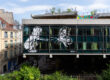

In the picturesque city of Grenoble, France, a provocative new piece of street art faces its residence—’Homo plisskën, a polemical mural by street artist Goin. Reflective of the artist’s hitherto confrontational aesthetic, the mural has sparked controversy and debates on its messaging, context, and relevance.
Installed on a local Grenoble school, the mural commandeers viewers’ attention with its impressive three-story height, and jarring dichotomy of content. It is a bold portrayal of the primitive and the modern, juxtaposing a prehistoric ‘Homo habilis’ and a contemporary ‘Homo consumericus.’
The inflammatory mural was commissioned by the atypical French street-art festival, ‘Street Art Fest Grenoble Alpes.’ Spanning the realm of street art since 2015, the festival, with its encouragement of out-of-the-box creativity, possibly anticipated reactions to Goin’s unique artwork.
The mural’s left side showcases an alienated image of ‘Homo habilis,’ a human ancestor, fully equipped with primitive tools in his mouth and hand, alluding to a simple survival mindset. On the right side, a stark contrast exists with the visually unappealing caricature of ‘Homo consumericus,’ or modern man. With a skull adorned with a crown, bulging stomach, and cocaine snorting, the character suggests a reckless consumer culture.
Goin, a Grenoble-born artist known for his politically charged works, has not stepped down from echoing social and environmental critiques in his mural. The work has been read as a critique on current consumer culture, drawing on the stark differences between the two human epochs.
Drawing the internet’s attention, social media conversations have ignited fresh debates about the artwork’s implications. A significant number of netizens argue that the mural champions an anti-consumerist sentiment, focusing on today’s culture’s wasteful habits. Others interpret the Homo consumericus figure as a critique on substance abuse, especially with the portrayal of cocaine use.
However, a conflicting segment of observers criticize the imagery as off-putting and inappropriate, considering the mural’s location on a school. Some argue its stark message may not be suitable for youth exposure and could stir unnecessary turmoil.
The striking depiction has garnered international attention, featured heavily in online art platforms and social media – from Instagram posts to ardent Twitter threads dissecting its meaning – the discussion is endless. In response, the city’s local governing bodies have not yet issued any official statements or taken action regarding these diverse interpretations and reactions.
Goin’s previous works share similar controversial reputations, drawing on dystopian themes and societal ills. The artist consistently uses his large-scale murals as an opportunity to highlight pressing societal issues.
Having been likened to Banksy for his socially conscious perspective, Goin made headlines in 2018 with his mural ‘The problem We All Live With,’ a depiction of a child walking towards a school guarded by two Ku Klux Klan members. This unequivocal image sparked massive controversy, further solidifying his reputation as an artist unafraid of confronting contentious issues.
Back in Grenoble, whether faced with approval or detestation, ‘Homo plisskën’ serves as a hard-to-ignore commentary piece on the city’s landscape. The dialogue it instigates could be the exact intention of the artist, using art not just for aesthetics, but as a tool to question the status quo and invoke thought about our present and future societal structures.
As society grapples with the impacts of consumer culture, from environmental degradation to mental health implications, Goin’s mural stands as a looming reminder in Grenoble. How this local controversy will evolve and whether it will impact the management and commissioning of public art in the future, remains to be seen. One thing is sure; Goin’s divisive art has made the city’s streets a hotbed of discussion.
Original Source: https://www.streetartbio.com/news/2016/06/27/goins-polemical-mural-in-grenoble-france/