

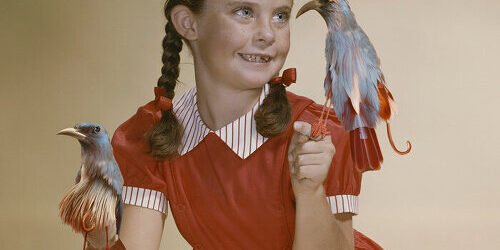
Polish visual artist Weronika Gęsicka, recently illuminated virtual discussions through her inventive creation: an encyclopaedic collection of fictitious entries, challenging our understanding of factual truth. Her experimental project begs a fundamental question – how reliable and unbiased are the sources we often use to define realities?
Gęsicka, renowned for her unique productions that intersect art and social science, has grasped the internet’s attention with this thought-provoking endeavor. By crafting an ‘Encyclopedia of Fake Entries,’ she encourages readers to question the supposed objectivity of standard informational sources and invites a broader exploration into the fluctuating nature of truth.
In a world where the concept of ‘truth’ is increasingly disputed amidst the rise of fake news and misinformation, Gęsicka’s innovative creation seems poignantly fitting. This project is a deliberate distortion of the encyclopedic model — an institution often associated with veracity and unbiased knowledge. Her “fictopedia” steers clear from universal truths and factual statements, instead curating its contents from a spectrum of dubious data, unverifiable facts, and abstract interpretations.
The disruptive project has instigated fascinating online discussions on multiple platforms. Virtual communities have found themselves engrossed by this examination into the credibility of facts, authenticity of sources, and the subsequent construction of ‘reality’.
Gęsicka’s work serves as a mirror to an era where ‘post-truth’ has become a significant part of the lexicon and misinformation can alter perceptions and influence decisions. By presenting a world knowingly fabricated, Gęsicka underlines the fine line between trust and skepticism that we tread in pursuit of knowledge. Her encyclopedia brings to the forefront the latent bias that could be encrypted in the supposedly ‘unbiased’ and ‘objective’ spaces of knowledge repositories.
Moreover, Gęsicka’s encyclopedia is encapsulated in intrigue, not only for its erroneous contents but also for its aesthetic appeal. Each fictitious entry is designed in a visually compelling format, echoing traditional encyclopedia layouts. This mirroring of visually reliable formats punctuates the artistic commentary on the deceptive appearances of authenticity.
Online, the ‘Encyclopedia of Fake Entries’ has drawn both acclaim and critique. Many appreciate Gęsicka’s work as a necessary reflection on the disinformation age, applauding her for cleverly forcing a conversation on truth and authenticity. Others view the project as a misleading parody of factual institutions, arguing that its existence could further blur the division between fact and fiction.
The diverging reactions further validate Gęsicka’s intent to provoke thoughtful discourse. The artist herself relishes the dichotomy, encouraging her audience to be skeptical readers, critical of the information presented to them, not just in her work, but from all sources.
In an era where the ease of information access is both a boon and a bane, Gęsicka’s ‘Encyclopedia of Fake Entries’ brings a refreshing perspective. It urges viewers to embrace uncertainty, embrace skepticism, and acknowledge the ever-present possibility of manipulation.
Enclosing imagination and critique within encyclopedia covers, Gęsicka has opened a Pandora’s box of falsehoods. The creation may be built upon non-existent facts, but its implications are real and invaluable. In an age where ‘all that is known’ can be easily manipulated, reality may just need to be questioned a little more often.
This artistic experiment delivers a significant message: Take nothing at face value. Investigate beyond the visible. Always question.
In its larger scope, Weronika Gęsicka’s ‘Encyclopedia of Fake Entries’ is more than a collection of fabricated facts. It’s a reflection on our relationship to truth in the 21st century, urging us to contemplate our interpretive approach towards reality and its sources.
Original Source: https://www.designboom.com/art/encyclopedias-weronika-gesicka-fake-entries-interview/


