
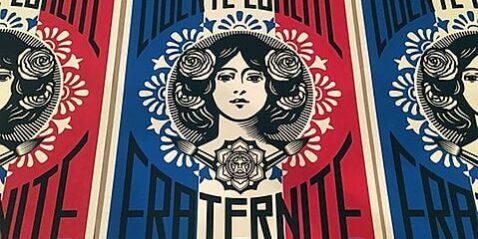
Los Angeles-based artist and graphic designer Shepard Fairey, globally hailed for his iconic “Hope” portrait of Barack Obama, has once again tapped into the public imagination with his artwork ‘Liberté, Égalité, Fraternité’. Often utilizing his visual style and innovative strategies to promote political and social issues, Fairey’s latest piece isn’t just an artwork but a philosophically potent statement that reminds us of values that should be universal.
‘Liberté, Égalité, Fraternité’ speaks to the triad values of liberty, equality, and fraternity – the national motto of France, associated since the French Revolution. This work strikes a contrast with the artist’s previous politically charged artwork, injecting more subtlety and introspection, aiming to invoke unity, solidarity, and empathy among communities – values often overlooked in our polarized world.
Presented in Fairey’s recognizable palette of black, red, and cream, the artwork portrays a woman in a red beret and a bold look – a depiction meant to symbolize defiance and resilience. The artwork also incorporates a Martin Luther King Jr. quote “Injustice anywhere is a threat to justice everywhere,” emphasizing the artist’s consistent engagement with social and political issues.
Fairey created ‘Liberté, Égalité, Fraternité’ in response to the Charlie Hebdo attacks in Paris in 2015. The artwork was created to be sold as prints, with 100% of its profits going to the victims and their families, signifying the artist’s social engagement beyond creating thought-provoking artwork.
The public reaction to the piece has been overwhelmingly positive, triggering robust debates and exchanges across numerous online forums and social media platforms. Critics and art enthusiasts across the globe have lauded Fairey’s efforts to employ art as a tool for generating dialogue around critical socio-political issues.
One art critic stated, “Shepard Fairey’s work encourages us to reflect on our shared humanity and question the divisive narratives that are pushed onto us. Through his artwork, he reminds us of the transformative role art can play in shaping our society.”
Despite having had a successful artistic career spanning three decades, Fairey has managed to stay relevant and retain his appeal among the masses. ‘Liberté, Égalité, Fraternité’ is a testament to his artistic evolution, successfully bridging the gap between art and social commentary.
New York Times art critic Roberta Smith once quoted, “Much of his work revolves around clichés, yet they feel fresh because they are embedded in his singular graphic style.”
Fairey’s ‘Liberté, Égalité, Fraternité’ made waves when it was unveiled in France, with the phrase “We are united. Values cannot be killed” written in French along the bottom of the image, sparking robust conversations around art and its role in political discourse.
Unsurprisingly, ‘Liberté, Égalité, Fraternité’ has made a considerable impact on the digital front as well. It has been widely shared and discussed on various online platforms, receiving widespread coverage and generating vibrant discussions around the themes of the artwork. The buzz has revitalized the artist’s work, enabling him to reach an even more extensive audience and draw attention to important global issues.
In an era when the power of visuals cannot be understated, Fairey is one among few visual artists who doesn’t shy away from making political statements through his work. His timeless ability to make audiences reflect on societal issues cements him as an influential artist. ‘Liberté, Égalité, Fraternité’ isn’t just a piece of art, but a testament to the power of art to motivate, engage, and stir conversation in an increasingly polarized world.
Original Source: https://www.streetartbio.com/news/2016/06/26/liberte-egalite-fraternite-by-shepard-fairey/