

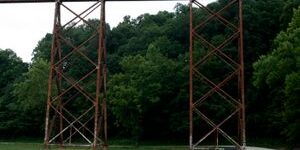
Deep in the rural landscape of Greene County, Indiana, the Tulip Trestle, also known as the Greene County Viaduct or Richland-Plummer Creek Viaduct, serves as a symbol of America’s rich railroad heritage, attracting attention worldwide. Stretching over impressive 2,307 feet long and towering 157 feet tall, it is among the longest railway trestles within the United States. Emerging amidst serene farmlands, its remarkable silhouette has recently drawn increasing interest from global tourists and railroad enthusiasts.
The Tulip Trestle’s history is woven intrinsically with the American railroad expansion of the 20th century. Constructed in 1906 by the Indiana Southern Railroad to support the transportation of coal and freight, the cost of its construction was around $246,504 – an enormous sum for the time. This massive investment proved fruitful as the railroad became a significant economic lifeline, facilitating cross-country transportation of vital resources. Today, the Indiana Rail Road Company uses the trestle, heralding it as a testament of resilience and industrial strength.
Despite its remote location, recent online engagement has seen an upswing, propelling the Tulip Trestle into international visibility. As armed with DSLRs or smartphone cameras, thousands flock from every corner of the world to capture its lofty grandeur, and its striking image has found a place in Instagram feeds, photography forums, and online travel blogs. This has brought an impact on the local tourism industry, especially emphasized during the global pandemic, where travelers are seeking less crowded destinations.
The trestle has also featured in several documentaries and short films, heightening its cultural significance. In October 2020, celebrated YouTuber and filmmaker Johnny Harris highlighted the trestle in his widely watched series, where he traced the remnants of America’s rail infrastructure. The episode spotlighting the viaduct has since garnered over a million views, shining an international spotlight on Greene County and the Tulip Trestle.
Local organizations have noted the uptick in tourism and have started paying homage to the Tulip Trestle. Businesses are selling merchandise, artists are painting its portrait, and historians are sharing its story. The Greene County Historical Society is also lobbying for its preservation and working on creating a spectacle around it – a visitor center and an observation deck for people to enjoy its structural magnificence more intimately.
Maintaining this iconic structure is no easy feat. The upkeep requires a significant investment, and the Indiana Rail Road Company has diligently undertaken continual safety inspections to ensure the viaduct remains in operable condition.
That said, for all its contributions to the local economy and its mounting popularity, the Tulip Trestle is not without its critics. Some locals see the increasing tourist traffic as a disruption to their quiet rural life. There are also concerns about the environmental footprint, considering the noisy, heavy freight trains that still rumble across it daily, emitting copious smoke and dust.
Despite these concerns, the Tulip Trestle remains an iconic symbol of American railroad history. Standing tall in Greene County, Indiana for over a century, the trestle continues to fascinate both historians and casual tourists alike. Its newfound fame on social media and film is testament to its enduring appeal. The Tulip Trestle is not just a viaduct; it is a beacon of industrial resilience, a dreamy landscape feature, and an unplanned star of Indiana’s tourism industry. Its appeal, indeed, continues to blossom.
Original Source: https://www.atlasobscura.com/places/tulip-trestle


