

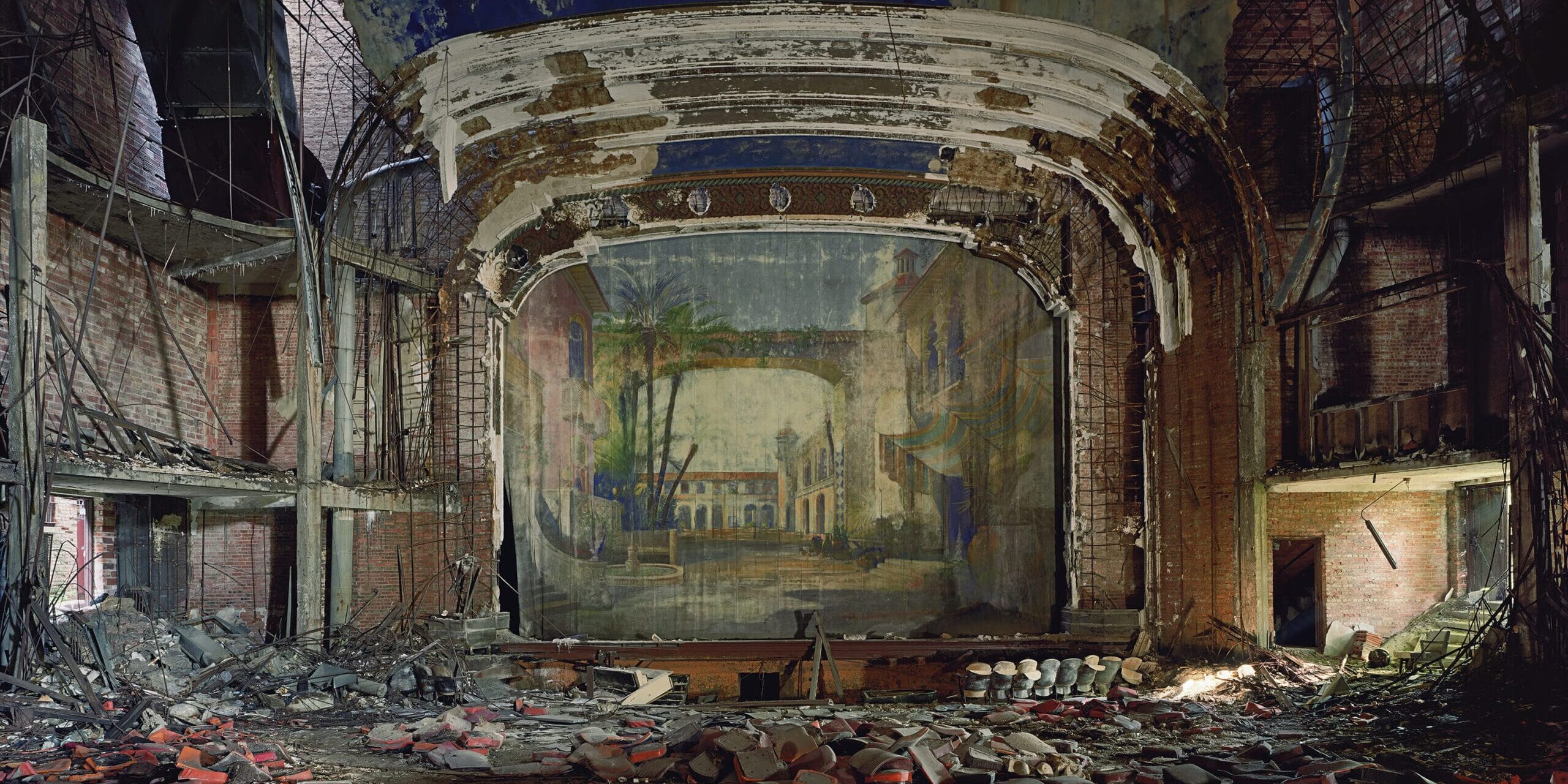
Andrew Moore, an eminent American photographer, has distinguished himself through his powerful representation of defunct architectures, symbolizing the intersection of time, nostalgia, and decay. His most recent work, a stirring series of theatrical photographs, has generated a number of online appreciations and a wave of critical discourse.
Each of Moore’s photographs tells a unique story of decay – a poignant testament to the ravages of time. His work engages with the past’s persistent relics, transmuted into poignant compositions that speak to the echoes of presence within absence. The potency of these images lies in their ability to seduce viewers into narratives of vanishing histories and receding pasts.
Throughout his decades-long career, Moore has documented everything from the crumbling beauty of Detroit to the haunting, abandoned spaces of the American rust belt, Cuba, and Russia. His lens has illuminated historical narratives through the framework of architectural decline and urban deterioration.
“There’s a certain catharsis in observing the poetic stillness of these disused spaces,” observes Natasha Ritsma, a contemporary art critic. “Moore’s work harmoniously marries nostalgia and decay in an unexpected display of theatricality, indicating an adept understanding of the intrinsic drama tied to the passing of time.”
This blend of theatricality, nostalgia, and decay is not only embodied in his choice of abandoned buildings but is also reflected in the way he portrays his subjects. The compositions teeter on the brink of surreal and palpable; the faded grandeur is rendered with an almost theatrical intensity, as if each photograph is a meticulously curated stage, awaiting the emergence of ghostly performers.
His work is not without its critics, however. Some consider Moore’s artfully curated images of decay as glorified ruin porn. Critics argue that focusing solely on the decay of once-thriving industrial towns and cities overshadows the people who remain, their struggles, triumphs, and day-to-day existence.
Despite this, Moore suggests in recent interviews that his work is aimed not at exploiting these spaces but at examining and documenting the beauty and sobering truth of these silent narratives. Through his lens, the crumbling architecture becomes a canvas reflecting the inescapable cycle of rise and decay—a tangible document of time passed.
Recently, Moore’s works have gained increased visibility online. In the era of social media where images are consumed at breakneck speed, his photographs have found a dedicated audience eager for their inherent drama and depth. The internet audience seems to appreciate the contrast between the fast-paced consumption of imagery and the lasting, resonant impact of Moore’s work.
Asynchronous discussions on platforms like Instagram and Twitter are in full swing, with netizens interpreting his works. These vigorous exchanges between admirers and detractors alike have further fueled interest in Moore’s photography.
Art historian Ted Manos observes, “Moore’s photographs provide a poignant commentary on the inexorable passage of time. In the face of contemporary debates about gentrification and urban redevelopment, his art takes on a new level of relevance.”
Indeed, Moore’s stark, impactful imagery is an invitation to look beyond the superficial gratification of the picturesque and theatrical. His blend of nostalgia, decay, and drama challenges viewers to question their perceptions of decline, prompting them to understand it as an inherent aspect of any narrative arc–a fading but persistent echo of what used to be.
As Andrew Moore continues to explore the forgotten corners and hushed narratives of decay and nostalgia, one can’t ignore the compelling visual legacy that he leaves in his wake. His photographs are a reminder of time’s impartiality—an artistic chronicle that silently testifies to history’s inexorable march. From the brink of forgotten times, they echo a haunting melody that remains etched in the annals of contemporary photography.
Original Source: https://www.thisiscolossal.com/2026/03/andrew-moore-theater-architecture-nostalgia-photographs/


