

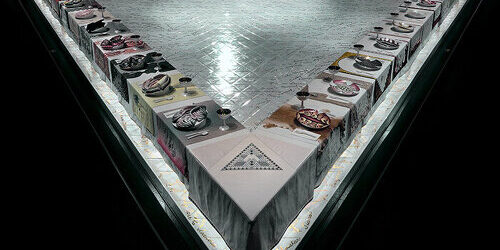
From her iconic installation ‘The Dinner Party’ to her unprecedented focus on feminist teachings in the classroom, internationally renowned artist Judy Chicago continues to use her practice as a platform to instigate a dialogue on global gender inequality. Bolstering a career that spans over five decades, Chicago is not only a pioneer in feminist art but has truly paved the way for a more inclusive art history that acknowledges the contribution of female artists.
Provocatively referred to as the ‘godmother of feminist art’, Chicago first burst onto the international scene in the 1970s, riding the wave of the second-wave feminist movement which called for women’s liberation and equality. Her groundbreaking installation, ‘The Dinner Party’, displayed at the Brooklyn Museum, features settings for 39 mythical and historical women who’ve left significant marks on society but are otherwise relegated or overlooked in standard historical accounts. By spotlighting their story, Chicago initiated a dialogue on female accomplishments that upends traditional gender biases.
Yet it is not only through her art that Chicago has sought to challenge the patriarchal lenses through which traditional art history is seen. In the early 70s, she co-founded the first feminist art program at California State University, Fresno. This program focused on female artists, fostering an inclusive community and curriculum that highlighted the significant contributions of women to the arts.
Chicago maintained her academic pursuit with the establishment of the Woman’s Building in Los Angeles, which permeated feminist practices in visual arts, graphic design, and literary arts for a span of two decades. This revolutionary work continues to have a profound influence on arts education even four decades later, inspiring a new generation of artists and academics to rethink the way art is taught and viewed.
In the digital era, Chicago’s work has garnered a resurgence of interest and online coverage. Featuring prominently in the Google Art Project, the online global anthology of high-resolution images from galleries worldwide, ‘The Dinner Party’ continues to reach a global audience. What’s more, an online course inspired by Chicago’s pedagogy, “Judy Chicago Art Education”, offers a comprehensive collection of resources such as participatory art pedagogy, teaching methodologies, and an archival collection of Chicago’s feminist art programs.
Addressing persistent gender biases from an intersectional perspective, Chicago opens up space for voices overlooked in mainstream art talks. Her significant impact is seen beyond the realm of contemporary art. New York Times art critic Holland Cotter labeled her an ‘anesthesiologist of the patriarchy’ for her continuous endeavors to unearth forgotten narratives in both her artistic and academic pursuits.
Chicago’s influence also transcends borders and cultures. It’s particularly resonant in countries such as South Korea, which has seen a surge in the women’s rights movement in recent years. Institutions like Seoul’s National Museum of Modern and Contemporary Art unveiled the exhibition “Judy Chicago: Los Angeles to Seoul,” marking Chicago’s first major retrospective show in Asia.
As a senior artist, Chicago continues to reshape the landscape of feminist art and art education. Utilizing her position within the arts sector, she challenges gender-biased narratives and reconstructs historic perspectives through a feminist lens, fostering a culture of equality and inclusivity.
All told, Judy Chicago’s visionary contributions to both the field of contemporary art and the discourse of feminist pedagogy make her an instrumental figure in the modern-day feminist movement. Her relentless pursuit of telling untold stories through her works and teaching embodies a genuine commitment to social change through art practice. No doubt, the echoes of her impact will continue to be felt for generations to come.
Original Source: https://www.designboom.com/art/dinner-party-feminist-classrooms-judy-chicago-lived-practice-change/


