

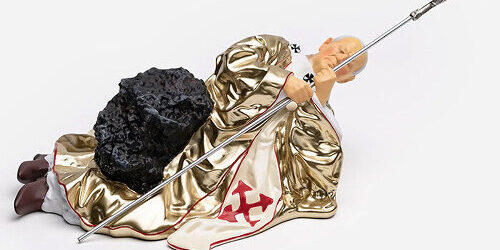
In an effort that pushes the boundaries of the art world, notorious Italian artist Maurizio Cattelan has developed an intriguing interactive project. The artistic creation is a combination of audio installation, religious redemption, and a touch of enigma. Participants who confess their sins to a voice recorder could possibly receive Cattelan’s newest masterpiece, a miniature sculpture of his controversial and famous work “La Nona Ora” (The Ninth Hour).
Famed for provocative and compelling sculptures, Cattelan is renowned for pushing the boundaries of satire, critique, and raw emotion. One of his most controversial works is “La Nona Ora”, a life-sized sculpture of Pope John Paul II being struck down by a meteor. This newly minted miniature edition of “La Nona Ora” is an art collector’s dream, and that fact is generating significant interest in Cattelan’s audacious new endeavor.
In keeping with his reputation as an elusive and subversive figure in the art world, Cattelan unveiled this project without fanfare. Various art blogs and social media platforms collectively discovered the initiative on his vague website. The page features a simple black screen and an invitation to confess your sins by leaving a voice message. The rules and guidelines are not expressly laid out, making this a cryptic endeavor in line with the unconventional artist’s style.
Participants who engage with the website are met with the message “Just confess, who knows what might happen” hovering over the input to record a message. The power of this message lies in the anonymity offered, reminiscent of a confession box. The promise that confession might lead to procuring a miniature “La Nona Ora” lends a daring twist to the concept.
Experts find this project revealing of Cattelan’s style, which often disrupts normative ideas about art, spectatorship, and the artist. Dr. Alice Bennett, an art historian based in New York, says, “Cattelan’s art frequently provokes audiences to question societal norms and engage in a self-reflective process. The confession project both embodies and amplifies these themes.”
Although some critics have raised ethical concerns regarding the exchange of penance for potential rewards, particularly involving a direct commentary on a significant religious figure like Pope John Paul II, the art world, on the whole, seems fascinated by the audacity of the project. Cattelan’s initiative has drawn attention from art lovers, intrigue seekers, and critics alike, making the confession sessions an eclectic mix of sincerity, curiosities, regrets, and unsuspecting sins.
As the buzz around Cattelan’s confession project grows, so does speculation regarding whether the project is art, a social experiment, or a commentary. In essence, it contains elements of all these classifications. By harnessing the power of human vulnerability and binding it with the lure of an exquisite sculpture, Cattelan has created a versatile canvas immersive of different experiences.
It is yet unclear how the winner will be selected or if there will be multiple winners, adding further to the mystery of the project. Cattelan’s spokesperson has remained tight-lipped about the initiative, maintaining only that it is “an experience and an experiment.”
In the end, the project has successfully kick-started conversations and debates centered around numerous social and artistic themes. Whether regarded as provocative, deeply introspective, or gloriously captivating, Cattelan’s confession venture illustrates the multilayered, disruptive nature of his body of work that continues to fascinate the contemporary art world.
Original Source: https://www.designboom.com/art/sins-maurizio-cattelan-fallen-pope-miniature-la-nona-ora/


