

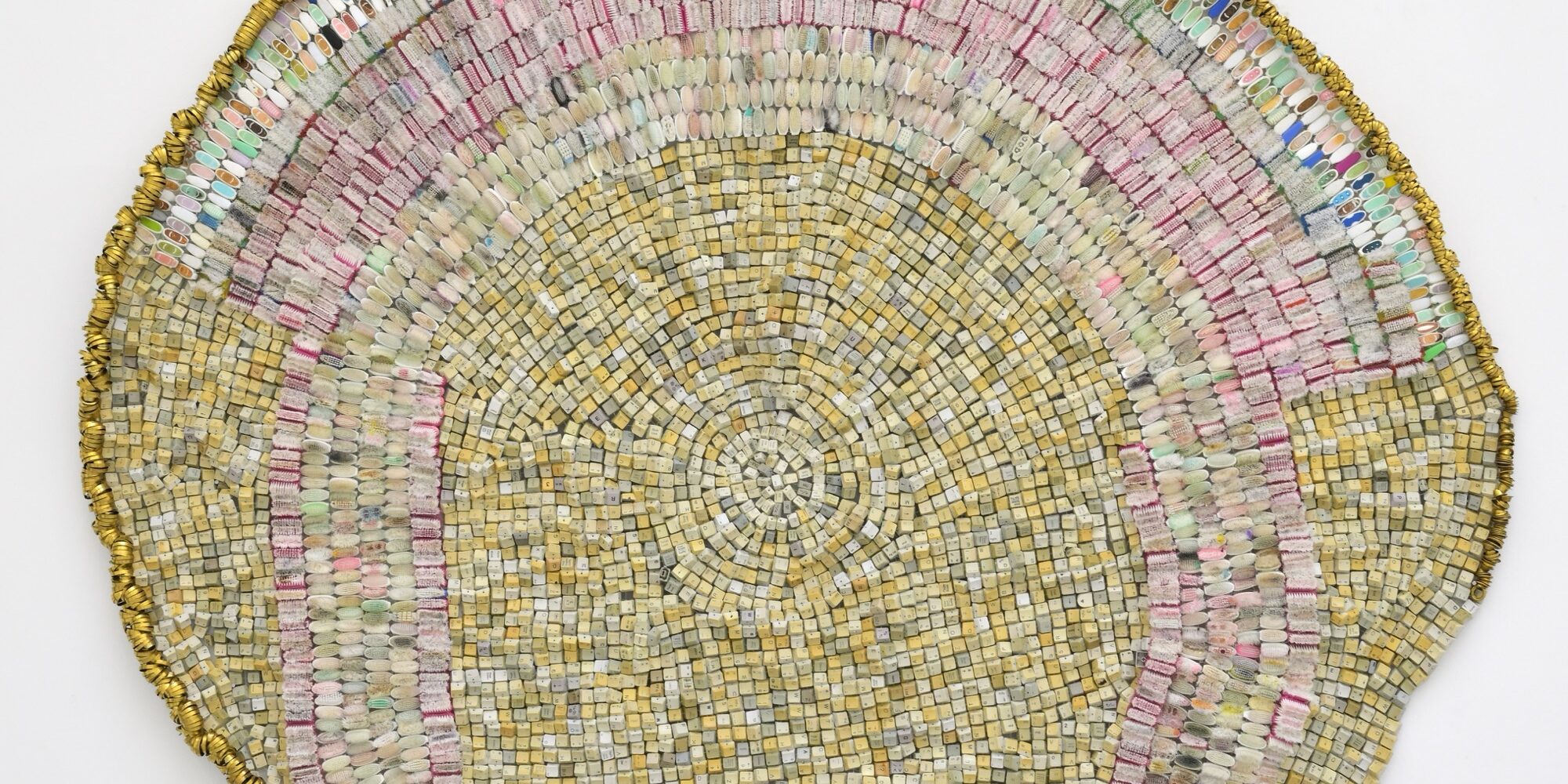
One of Zimbabwe’s leading contemporary artists, Moffat Takadiwa, is unearthing Africa’s colonial past through found materials. Renowned for his distinctive large-scale wall sculptures, created from discarded items such as toothbrushes, keyboards and aerosol cans, Takadiwa’s art has been garnering attention worldwide.
Often described as ‘scrounged sculptures’, these pieces, vibrant and textured, serve as symbols for the rejection of the imposed Western values that remain deeply rooted in the African culture. Telling the story of Africa’s colonial history through a new visual language, they represent the artist’s commentary on the colonial hangover, a term used to describe the enduring influence of colonial rule in Africa.
Born in 1983 in Karoi, Zimbabwe, Takadiwa graduated from the Harare Polytechnic University, Zimbabwe in 2008. His work has since been exhibited across Africa, Europe, Asia, and North America. According to a feature by ARTnews, Takadiwa’s work puts emphasis on the disparities ‘borne out of colonial narratives and the harsh realities of neocolonial structures’.
His most noted work to date, Say Hello to English, was a tribute to Zimbabwe and the struggle its people faced in the English-dominated world. Formed from discarded keyboard keys, it visually connects the issue of environmental pollution with the legacy of colonialism.
In an interview with BmoreArt, Takadiwa explained, “My work is a reaction to the environment in which I live, in a broader continental and global context. The issues I grapple with touch on linguistic imperialism, environmental issues, education and religion.”
Recently exhibited at the Nicodim Gallery in Los Angeles, his Say Hello to English series further expands on these themes. With sculptures crafted from found English leather shoes and Anglican prayer books, Takadiwa investigates the imposed English cultural symbols in Africa. He brings up the conversation about language as a tool used by colonizers and the complexities involving post-colonial identity.
In another piece, Foreign Objects, Takadiwa uses waste materials sourced locally from Harare. The sculpture reflects global mass consumption and the flow of construction materials that have helped shape post-colonial structures in Africa. Woven together, these discarded objects create captivating wall sculptures that translate into sophisticated statements about power, consumption, and marginalized communities.
In a continent still reeling from the effects of colonial paternalism, Takadiwa’s art confronts and challenges the viewer to unpack the deeper symbolic meaning. Art critic Jepchumba, writing for Art Base Africa, suggests that “Takadiwa’s work is vital in this historical moment, his assemblages of discarded daily life objects point towards Africa’s struggle to erase the vestiges of colonial history.”
By turning the mundane into the extraordinary, Takadiwa not only changes the way viewers perceive waste but provokes them to reflect on the continued entanglement of Africa with its colonial past. His efforts echo the words of Frantz Fanon, a well-known post-colonial theorist, who wrote, “Colonialism is not a thinking machine, nor a body endowed with reasoning faculties. It is violence in its natural state, and it will only yield when confronted with greater violence.”
The 21st century has given birth to an era of artists using found materials for art-making, but what makes Moffat Takadiwa stand out is his unique ability to imbue waste materials with history and political commentary. His work is far more than aesthetics—it is a dialog, a silent yet loud challenge to the colonial history of Africa.
With his ever-increasing profile and exhibition presence, it will be interesting to see how Moffat Takadiwa continues to explore themes of neocolonialism and cultural identity, further illuminating Africa’s colonial hangover through his intricate, thought-provoking art.
Original Source: https://www.thisiscolossal.com/2026/04/moffat-takadiwa-the-crown-sculptures-post-consumer-waste-africa/


