

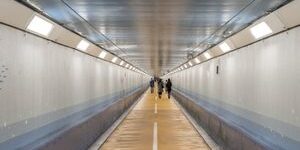
The Kanmon Pedestrian Tunnel, located in Shimonoseki, Japan, is a significant subterranean pathway stretching approximately 780 meters beneath the Kanmon Straits. This unusual construction, connecting Yamaguchi Prefecture with Fukuoka Prefecture on the island of Kyushu, stands out not only for its engineering but also for its cultural relevance and practical implications for local transit.
Key details
Opened in 1958, the Kanmon Pedestrian Tunnel was initially built to facilitate pedestrian traffic across the busy straits, providing an alternative to crossing on ferries or bridges. The tunnel was designed with a width of 3.3 meters, allowing pedestrians to walk comfortably, and includes elevators and escalators to ease access at both ends. Above, heavy marine traffic regularly navigates the straits, making the tunnel an essential feature for safety and convenience.
One of the unique aspects is the depth at which the tunnel is situated—about 20 meters below sea level—making it the longest pedestrian tunnel in the world that passes under a body of water. The structure comprises reinforced concrete, a necessary feature given the geological conditions of the region.
Why this matters
The Kanmon Pedestrian Tunnel serves multiple vital functions. Primarily, it enhances pedestrian safety, allowing individuals to traverse the straits without competing with vehicular traffic. This is particularly important in promoting foot traffic, which can positively affect local businesses and tourism.
Moreover, the tunnel plays a role in regional connectivity. It not only links two prefectures but also fosters a sense of community by allowing residents to engage more freely in cultural and economic exchanges. Events and festivals celebrating local heritage are often held on either side of the straits, bolstering the social fabric of the region.
In a broader context, the tunnel represents an essential piece of infrastructure that reflects Japan’s commitment to innovative solutions in urban planning. By prioritizing pedestrian pathways, it sets a precedent for future developments, emphasizing accessibility and safety in densely populated areas where traditional transport options may be limited.
Broader picture
As cities around the world seek sustainable solutions to congestion and urban sprawl, the Kanmon Pedestrian Tunnel offers valuable insights. Japan’s investment in pedestrian infrastructure aligns with global trends advocating for walkable cities, encouraging healthier lifestyles while addressing environmental concerns linked to vehicular emissions.
In addition, the tunnel has pushed forward discussions on the importance of including pedestrian-focused investments in regional planning. As urban centers become increasingly crowded, the necessity of such infrastructure becomes more pronounced, drawing attention to both the utility and the quality-of-life improvements it can bring.
Ultimately, the Kanmon Pedestrian Tunnel symbolizes not only a practical solution to transportation challenges but also an illustrative example of community-oriented design. As other regions consider similar projects, the lessons learned from Shimonoseki may help shape the future of urban connectivity worldwide.
Original Source: https://www.atlasobscura.com/places/kanmon-pedestrian-tunnel